
"Rooted Patterns: Where Our Attention Really Comes From"
Our attention isn't as free as we think. The brain follows patterns, many of them formed in childhood, and awareness often comes second.
AS
Counsellor
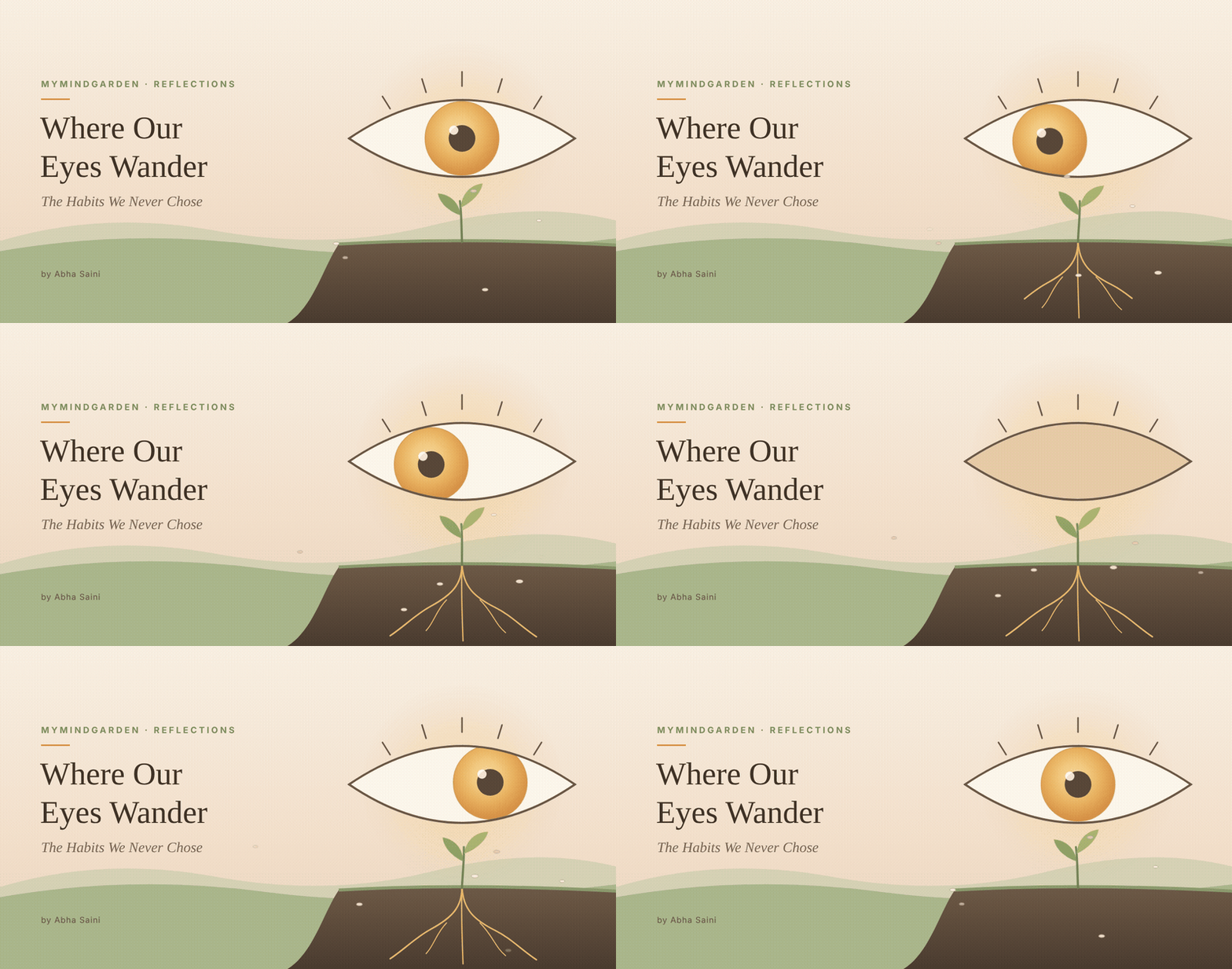
When we go out, where do we usually look? You might say at people, places, trees or the sky. Let's begin our friendship with a little more honesty. With people, we notice the way they are dressed, who they are with, and the rest, you name it. Places have become trophies for the camera lens, rather than something we take in with our own eyes. Why is that? Let's explore it together.
What and Where Is Our Brain Focused?
Why do we look at only certain things and ignore others? Our brain takes in far more than it can process, so it filters. It leans on familiar patterns, and in that process, awareness often takes a back seat.
What we notice is itself a habit. And like most habits, it was learnt somewhere. Let's start with the little habits we rarely stop to observe. Have you noticed people gravitating towards certain colours and avoiding others? What do we like to eat the most? Where do we like to spend our weekends? What do we reach for on days when we feel low? Doomscrolling certain kinds of content... oh, there is so much to dig into. These choices feel like ours, and many of them are. But some of them began long before we were old enough to choose.
The Childhood Bubble:
Let's step back into childhood. The habits our parents and caregivers passed on to us have shaped a large part of who we are, often more than we realise. This is rarely a matter of blame. Our parents, too, often passed on what they themselves received.
Habits can take months to build, and breaking one can take far longer. Think about a few of your own reactions. If you tend to shut people down, is it because you want to feel calmer, or because the parent you depended on most did the same? If you feel defensive whenever confrontation comes around, is it because you want to tell your story, or because someone close to you had that same habit, one they learnt from their own caregivers? The loop can carry on for generations. So how do we recognise whether the things we do today are habits we absorbed unconsciously, or habits we chose and worked on ourselves?
How to Recognise an Inherited Habit:
There is no single test, but there are gentle signs worth paying attention to.
1. Notice the speed of the reaction: Habits learnt early tend to arrive fast, before we've had time to think. If a reaction shows up instantly and feels bigger than the moment, it may be older than the moment too.
2. Listen for a familiar voice: Sometimes you'll hear yourself say something and realise it sounds exactly like a parent, grandparent or teacher. That echo is a clue, not a verdict.
3. Ask, "Does this still serve me?" An inherited habit isn't automatically a bad one. Ask whether it helps you in your life today, or whether it once protected you in a situation that no longer exists.
4. Keep a short reaction journal:For one week, jot down the moments you reacted strongly: what happened, what you felt and what you did. Patterns we can't see in the moment often become clear on paper.
5. Talk to the people who knew you young: A sibling, parent or old family friend can often tell you, "You've done that since you were small," or "Your father was exactly the same."
6. Seek support when it feels heavy: Some patterns are tied to painful experiences. A counsellor or therapist can help you explore them safely and at your own pace.
Tending Your Own Garden:
Recognising a habit is not about rejecting where we come from. Think of it as tending a garden you inherited. Some plants you'll keep with gratitude, some you'll prune, and some you'll gently replace with something you planted yourself. Change is slow, and that's okay. Awareness is the first seed.
Summary
- Watch where your eyes go: On your next outing, notice what you look at first: people's clothes, your phone camera, or the world around you.
- List your small defaults: Write down your go-to colours, foods, weekend plans and low-day comforts, including what you scroll.
- Trace one reaction back: Pick one habit, like shutting people down or getting defensive in conflict, and ask: "Did I choose this, or did I learn it at home?"
- Keep, prune or replace: Decide whether the habit still serves you before trying to change it.
- Be patient and kind with yourself: Habits form slowly and take even longer to undo, so treat this as gentle observation, not self-judgement.
This article is for reflection and self-awareness. It is not a substitute for professional mental health care. If you are struggling, please reach out to a qualified counsellor or therapist.